
What Is a Social Rating? How Social Ratings Work Between People
A clear look at what a social rating is, how people form reputations, and why community perception can shape how someone is seen.
A social rating is, at its simplest, a way of turning social reputation into something people can actually see. It does not mean reducing a person to a number. It means taking the things people already notice about each other — reliability, personality, trust, humor, energy, drama, loyalty, and general presence — and expressing those impressions in a more structured way.
We already do this informally every day. We call someone dependable, say a friend always disappears when plans get serious, or describe another person as funny, awkward, intense, chill, dramatic, trustworthy, or impossible to read. A social rating takes those scattered impressions and organizes them.
What does “social rating” actually mean?
The phrase can mean different things in different contexts. In some industries, it refers to formal assessments of social performance. In online communities, however, a social rating can describe how a person is perceived by other people based on shared experiences, reputation, behavior, and personality.
That second meaning is the one most people recognize instinctively. If several people describe someone as dependable, that person starts to develop a reputation for reliability. If people repeatedly say someone cancels plans, creates conflict, or dominates every conversation, those patterns also become part of their social reputation.
A social rating simply makes those patterns easier to understand. The important part is that the rating comes from collective perception, not from a single person declaring what someone is like.
Social ratings already exist in everyday life
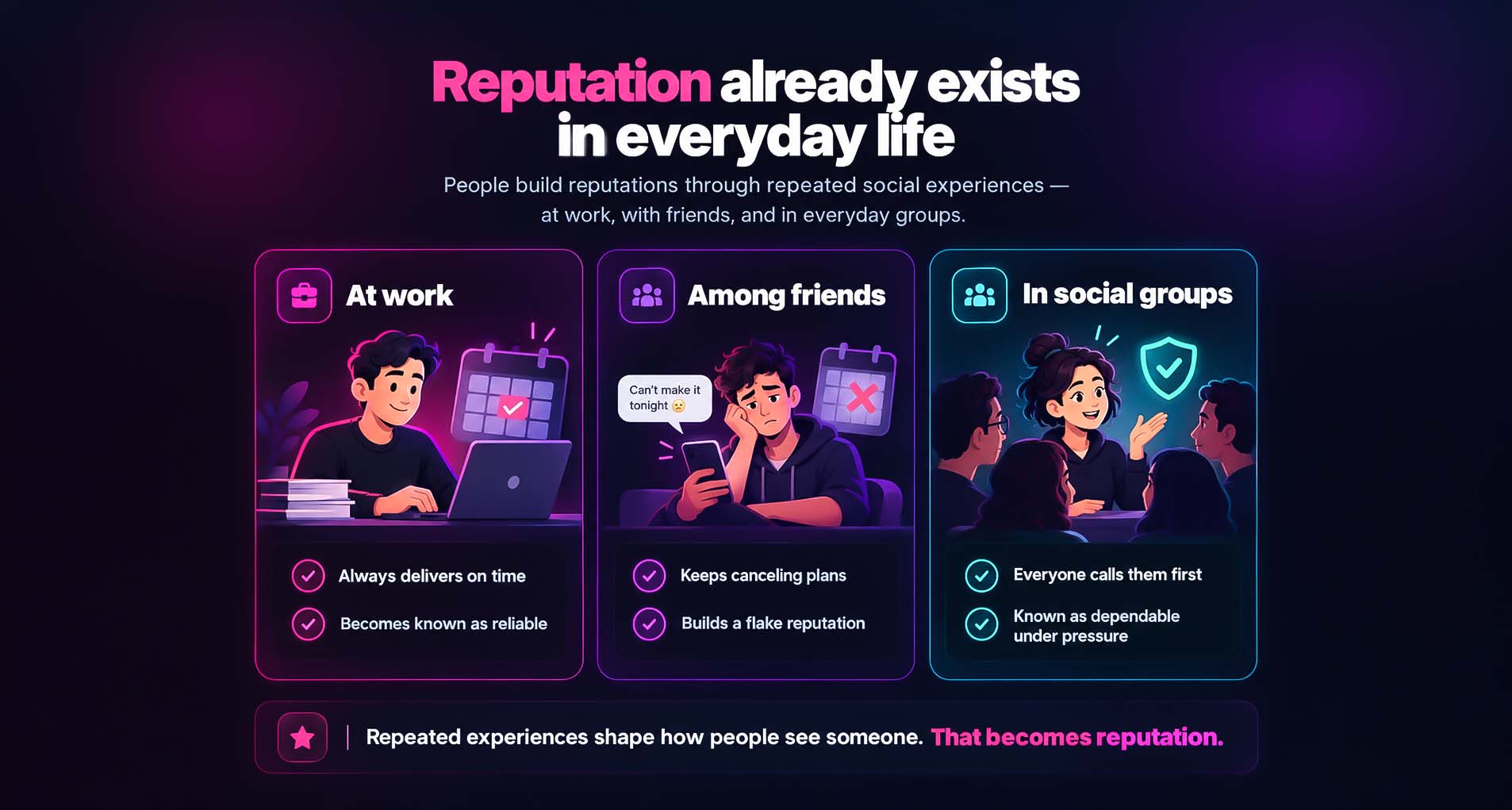
People may not call them social ratings, but informal reputation systems are everywhere. At work, certain colleagues become known as the people who always deliver on time, while others become known for disappearing when deadlines arrive. Inside friend groups, someone might be the person everyone calls when something goes wrong, while another becomes famous for canceling plans at the last minute.
Dating has its own reputation signals too. People talk about whether someone communicates well, keeps promises, handles conflict maturely, or vanishes without warning. None of these impressions begin as numbers. They begin as repeated experiences, and over time, repeated experiences become reputation.
That is why social ratings are more interesting when they measure different traits instead of asking one vague question like, “Is this person good or bad?” People are more complicated than that.
How social ratings work between people
A useful social rating system usually starts by separating reputation into different dimensions. One person may be extremely funny but unreliable. Another may be dependable but socially distant. Someone else may have a great personality while also being the source of half the drama in their friend group.
On Social Ratings, people are rated across seven separate traits:
- Vibe Check — overall energy, presence, and how someone feels to be around
- Flake Factor — how reliable or unreliable they tend to be
- Drama Meter — how often conflict or chaos seems to follow them
- Personality & Banter — humor, conversation, and social chemistry
- Relationship Material — how people perceive them in a relationship context
- Aura Score — confidence, presence, and that harder-to-explain social pull
- Clutch Score — whether they show up when it actually matters
Each trait captures a different part of reputation. That matters because two people with the same overall score could have completely different social profiles. One might score highly because they are dependable and supportive. Another might be charismatic, funny, and unforgettable while being slightly chaotic.
The number alone does not tell the whole story. The pattern does.
Why community ratings can be more useful than one opinion
One person’s opinion can be unfair, emotional, outdated, or based on a single bad interaction. That is one of the biggest weaknesses of judging people socially. Community ratings become more meaningful when multiple independent opinions begin pointing in the same direction.
If one person says someone is unreliable, that is an opinion. If ten unrelated people consistently rate the same person poorly for reliability, a pattern starts to appear. The same applies to positive traits. A person who repeatedly receives strong ratings for personality, trustworthiness, or showing up for others is developing a reputation through repeated social feedback.
That still does not make the rating an objective truth. Social reputation is subjective by nature. What it can do is show how someone is commonly perceived, and that distinction matters.
A social rating is not a measure of someone’s worth
There is an obvious danger with any rating system involving people: treating the score as if it defines the person. It does not. People behave differently around different groups, and the same person can come across very differently depending on the situation.
Someone may be quiet at work and hilarious with close friends. A person who seems unreliable to one group may be carrying responsibilities nobody else knows about. Reputation is context-dependent, which is why a thoughtful social rating system should be treated as a snapshot of community perception rather than a permanent label.
Scores can change. Opinions can change. People can change. The interesting part is not declaring who someone permanently is, but seeing what kind of reputation they have built at a particular point in time.
Why people care about social reputation
Humans are unusually sensitive to reputation because social trust has always mattered. We want to know who keeps promises, who can be trusted with information, who makes a group better, and who might make things unnecessarily difficult.
Before online platforms existed, this information moved through conversation: “Ask her, she always knows what to do.” “Do not rely on him for plans.” “She is quiet at first, but actually hilarious.” “He somehow knows everybody.” Those statements are small pieces of reputation data.
Modern social platforms simply make those signals easier to collect, compare, and discover. There is also curiosity involved. People naturally want to know how others see them, and the difference between how we see ourselves and how other people experience us can be surprisingly large.
That gap is part of what makes social ratings interesting.
The difference between ratings and reputation
A rating is a data point. Reputation is the larger story created by many data points over time. That is an important distinction because a single low rating should not suddenly redefine a person, just as one glowing review does not automatically create a strong reputation.
Patterns matter more than isolated opinions. This is also why titles, comments, and trait-level ratings can sometimes tell you more than the final score itself. A nickname voted up by a community might reveal something everyone seems to recognize about a person, while a short comment may explain why people consistently rate someone highly for reliability or poorly for drama.
The overall number is useful, but the surrounding context is where the personality appears.
How Social Ratings approaches the idea
Social Ratings is built around the idea that reputation should be more detailed than a simple thumbs-up or thumbs-down. Community members can rate profiles across seven traits, contribute short comments, and vote on community-created titles. Individual trait ratings use a 1-to-5 scale, while the combined profile is aggregated into an overall score out of 8.0.
The goal is not to produce a scientific measurement of someone’s personality. It is to make community perception visible in a structured, easy-to-understand way. That is also why different traits matter. Someone can have a great Vibe Check while having a questionable Flake Factor. Someone else might be low-drama, dependable, and still receive an average Aura Score.
Real people rarely fit neatly into one number.
Closing thoughts
A social rating is best understood as a structured version of something people have always done: build reputations through shared experiences and word of mouth. The technology is new, but the social behavior is not.
What changes online is that those scattered impressions can be collected in one place, compared across different traits, and updated as more people contribute. That does not make a social rating the final word on a person. It makes it a window into how that person is currently seen by a community.
And sometimes, that gap between who we think we are and how other people experience us is the most interesting rating of all.